

Best Boomerang & Bolster Pillows for Back Support 2026
If you woke up at 4 a.m. with a stabbing pain in your lower back, or your ear is sore from being mashed against a too-firm pillow, or you can never get comfortable enough to read in bed without your neck cranking forward — you don't need a new mattress. You need a specialty-shape pillow. Boomerang pillows (V-shaped) prop you up for reading and cradle a sore arm. Bolster pillows (cylindrical) slide under your knees to fix lower-back pain at night and double as a neck roll. They are the smallest pillows in any catalog and the ones that solve the most specific problems.
This guide is for people who already know they have a specific issue — lumbar pain, reading-in-bed strain, ear pressure, cervical stiffness — and want to know which shape, fill, and firmness actually solve it. We've ranked the five best specialty-shape pillows in the Husband Pillow lineup, including the boomerang body pillow we recommend for arm support, the microbead bolster we hand to chiropractor patients, and the buckwheat-hull bolster for sleepers who want firm, ergonomic support that holds its shape for a decade.
These aren't your primary head pillow. They're the second pillow that turns a frustrating sleep setup into a working one.
What's the Difference Between Boomerang, Bolster, V-Shape, and Wedge Pillows?
These four terms get used interchangeably online, and they shouldn't be. Here's the actual breakdown.
Boomerang pillow (also called V-shape): A pillow bent at roughly a 100–120° angle, with two long "arms" extending from a central back. The shape wraps around your shoulders and supports the upper back, head, and both arms simultaneously. Originally designed for hospital patients who needed to sit upright after surgery, boomerang pillows are now the go-to for reading in bed, nursing a baby, or sleeping in a semi-reclined position to manage acid reflux or sleep apnea.
Bolster pillow: A long, cylindrical pillow — typically 10–20 inches long and 6–10 inches in diameter. The cylinder shape is the key feature: it slides under your knees, behind your neck, behind your lower back, or under your hips without compressing into a flat lump the way a rectangular pillow does. Bolsters come in microbead, buckwheat hull, memory foam, and fiber fills, each with different firmness profiles.
V-shape pillow: Functionally identical to a boomerang. The terms are often used interchangeably; "V-shape" tends to be used in the U.K. and "boomerang" in the U.S. and Australia. If a product is called either, expect the same approximate geometry.
Wedge pillow: A triangular, ramp-shaped foam pillow used to elevate the upper body or the legs. Unlike a boomerang (which wraps around you), a wedge is a static incline you lie on top of. Used for GERD, sleep apnea, post-surgical recovery, and leg elevation. We don't cover wedge pillows in this guide — they're a separate category, and we have a dedicated bed rest pillow guide and backrest pillow roundup for that need.
Half-moon bolster: A bolster cut lengthwise so it has a flat bottom and a curved top — half a cylinder. The flat bottom prevents it from rolling, which makes the half-moon ideal for lumbar support behind your lower back while sitting or for under-knee elevation in bed. See our half-moon bolster pillow guide for the full breakdown of that variant.
When to Use a Boomerang Pillow
Boomerang pillows solve a specific set of problems that a regular pillow can't.
Reading in bed without neck strain. If you read or watch TV propped against the headboard, a flat pillow behind your back forces your head to crane forward to maintain a level gaze at the page or screen. Within 20 minutes your neck is aching. A boomerang's two arms wrap forward and support your upper back and head simultaneously, holding your cervical spine in neutral while you read. This is the single most-reported use case in our customer reviews for the boomerang shape.
Side sleeping with arm and chest support. When you side-sleep, your top arm tends to drop across your chest, which over the course of the night rotates your upper torso and creates upper-back stiffness. A boomerang's top arm acts as a draping surface for your top arm — you can rest it forward on the pillow rather than letting it collapse. Pregnant side sleepers, post-mastectomy patients, and anyone with rotator cuff issues use the boomerang this way.
Nursing and feeding support. New mothers use boomerang pillows to support a baby across the lap during breastfeeding. The wrap-around shape holds the baby at chest level without requiring the mother to hunch forward — which is the #1 cause of postpartum upper-back pain.
Post-surgical and post-cardiac recovery. After abdominal surgery, chest surgery, or any procedure requiring a semi-upright sleeping position, hospitals frequently send patients home with a boomerang or V-shape pillow. It's specifically designed to maintain a 30–45° incline overnight without the patient sliding down (the way you would on a stack of flat pillows).
Acid reflux and GERD. Sleeping at a slight incline is one of the most effective non-medication interventions for nighttime acid reflux. While a wedge pillow is the more common solution, a boomerang gives you a similar elevation with arm support — so you can sleep semi-reclined and not feel like you're going to roll off.
When to Use a Bolster Pillow
Bolster pillows are the workhorse of specialty pillows — small, cheap, and absurdly versatile. Here are the five most common use cases.
Under your knees to relieve lower back pain. This is the single most evidence-supported use of a bolster. When you sleep on your back with your legs flat, your pelvis tilts forward and creates a gap under your lumbar spine, which forces your lower back muscles to hold tension all night. The American Chiropractic Association and the NIH MedlinePlus guide on lower back pain both recommend placing a small pillow or bolster under your knees during back sleep to relieve this tension. A 6-inch bolster is the right size for most adults.
Behind your lower back when sitting up in bed. A small bolster placed in the curve of your lumbar spine while you sit up to read or work prevents the slouching that causes lower back pain after extended sitting. Office workers use the same trick on their desk chair.
As a neck roll. A small cylindrical bolster (8–14 inches long, 4–5 inches in diameter) under your neck while you back-sleep cradles the cervical curve in a way that a flat pillow cannot. The Cleveland Clinic notes that cervical roll pillows can reduce morning neck stiffness for back sleepers with chronic cervical tightness.
Between the knees for side sleepers. Side sleeping without a pillow between the knees lets the top leg fall across the bottom leg, which rotates the pelvis and torques the lumbar spine all night. A medium-length bolster (14–20 inches) between the knees fixes this. Pregnant side sleepers in particular benefit from this alignment.
Under the hips for stomach sleepers. If you sleep on your stomach, slipping a 2–3 inch bolster under your hips and lower abdomen restores the lumbar curve that gets flattened in the prone position. This is the single most effective adjustment a stomach sleeper can make for back pain. We cover this in detail in our stomach sleeper pillow guide.
Our Top 5 Specialty-Shape Pillows
#1: Boomerang Body Pillow (V-Shaped Side Sleeper)
Best for: Side sleepers who want arm and chest support, readers, pregnant women, post-surgical recovery.

Price: $44.95 | Shape: V-shape boomerang | Fill: Polyester fiber | Cover: Removable, machine washable, white cotton-blend
Shop the Boomerang Body Pillow →
The Boomerang Body Pillow is what most people picture when they hear "V-shape pillow" — a wide-armed wrap that supports your upper back, both shoulders, and your head in one piece. Side sleepers thread one arm under one wing of the boomerang and rest the other across the opposite wing, so both shoulders are supported simultaneously. That stops the forward-shoulder roll that causes upper-back tightness over the course of the night.
The wide footprint also makes it the best reading pillow in the lineup at this price. Sit up against the headboard, fit the boomerang around your shoulders, and the two arms hold your head and back in neutral alignment while you read. No more 20-minute reading sessions that leave your neck stiff for the rest of the day.
The polyester fiber fill is intentionally medium-soft — boomerangs aren't meant to be firm support pillows. They're meant to wrap. If you want firm support, look at the bolster picks below or the Aspen XXL.
Pros / Cons
| Pros | Cons |
|---|---|
| Wide wrap supports both shoulders + head | Polyester fiber compresses faster than foam |
| Excellent for reading in bed | Single-color (white) availability |
| Doubles as a pregnancy / nursing pillow | Larger footprint than a standard pillow |
| Removable, machine-washable cover | Not firm enough for chronic neck pain |
| Affordable at $44.95 | Will lose 20% of loft within 12 months |
---
#2: Microbead Bolster / Log Roll Pillow
Best for: Under-knee support during back sleeping, neck roll for back sleepers, lower-back lumbar support while sitting up.
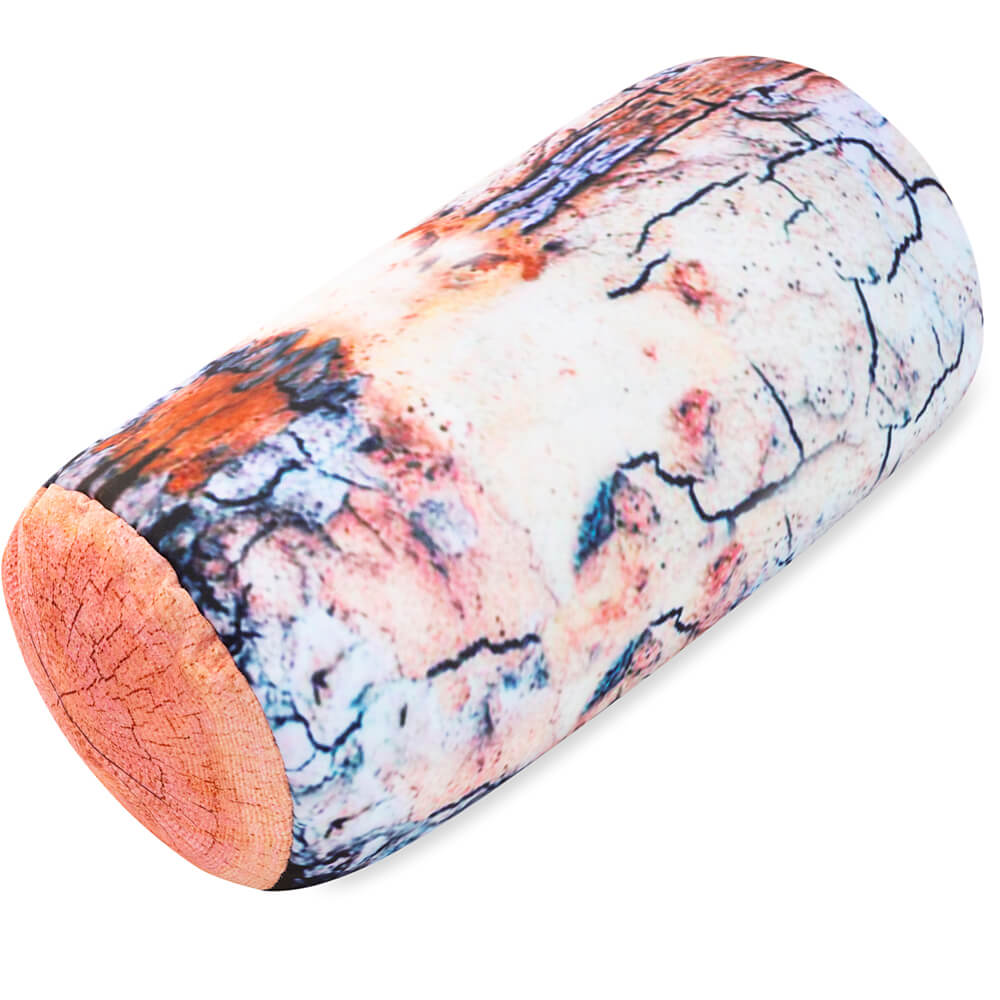
Price: $24.95 | Shape: Cylindrical bolster | Dimensions: ~14" × 8" | Fill: Polystyrene microbeads | Cover: Silky-feel polyester, removable
Shop the Microbead Bolster Pillow →
The Microbead Bolster is the cheapest pillow on this list and the one we recommend most often to people calling about back pain. At $24.95, it does five jobs: under the knees for back sleepers, behind the lower back while sitting up, as a neck roll, between the knees for side sleepers, or under the hips for stomach sleepers. The microbead fill is the secret — the polystyrene beads shift continuously to match the contour of your body, which means the bolster doesn't develop a flat spot the way fiber-fill bolsters do.
The 14" × 8" size is intentionally the most versatile dimension we sell. Big enough to span an adult's knee-to-knee distance for side sleepers, small enough to slide under your neck or hips without taking over the bed. The silky cover is the kind of detail that doesn't sound important until you've slept on it — it doesn't catch on pajamas or sheets the way cotton does.
If you only buy one specialty-shape pillow on this list, make it this one. Most customers who order it for one reason (say, under-knee support for back pain) end up buying a second within three months for a different use case.
Pros / Cons
| Pros | Cons |
|---|---|
| $24.95 — most affordable specialty pillow | Microbead "shifting" sound bothers some sleepers |
| Microbeads conform without flattening | Single 14"×8" size — no length variants |
| Versatile: knees, neck, hips, lumbar | Cover is polyester (no cotton option) |
| Silky cover doesn't catch on bedding | Not as firm as buckwheat or memory foam |
| Travel-friendly — compresses for packing | Polystyrene beads aren't sustainable |
---
#3: Husband Pillow Aspen Edition XXL (the Upgrade Pick)
Best for: Anyone who wants a backrest, a bolster, and a reading pillow in a single piece — and is willing to pay for the upgrade.

Price: $109.95 | Shape: Backrest with arms + detachable neck roll bolster | Fill: Premium shredded memory foam | Cover: Reversible microsuede / microfiber, machine washable
Shop the Husband Pillow Aspen XXL →
The Aspen XXL is what you buy when you've worn out a $25 bolster and a $45 boomerang and you've decided you want the whole problem solved in one piece. It's the largest pillow in our lineup, with a tall backrest, two arm supports, and a detachable neck roll bolster that magnetically attaches to the front edge. The neck roll is the key feature for this guide — it gives you cervical support while reading or sitting up in bed without needing a second bolster pillow.
The shredded memory foam fill is premium-grade — the same fill we use in our flagship Wife Pillow line. It holds its shape under heavy use (this is the pillow we recommend for sleepers over 200 lbs or anyone who spends 3+ hours a day reading or working from bed) and breathes far better than solid memory foam. The reversible cover gives you a microsuede side (warmer, plushier) and a microfiber side (cooler, smoother) — flip it depending on the season.
This is the upgrade pick. If your specialty-shape need is occasional, buy a $25 microbead bolster. If it's a daily thing — you read in bed every night, you have ongoing lower-back issues, you work from bed — the Aspen XXL pays for itself in six months.
Pros / Cons
| Pros | Cons |
|---|---|
| Backrest + bolster + arm rests in one piece | $129.95 — the most expensive option here |
| Detachable neck-roll bolster (magnetic) | Large footprint — eats half a queen bed |
| Premium shredded memory foam holds shape | Heavy — 8+ lbs |
| Reversible microsuede/microfiber cover | Bulky to launder |
| Pairs with arm-hole Wife Pillow for the full system | Not a travel pillow |
---
#4: Organic Buckwheat Hull Bolster
Best for: Sleepers who want firm, ergonomic support that lasts a decade — and don't mind the rustling sound of buckwheat hulls.

Price: $49.95 | Shape: Cylindrical bolster | Fill: 100% organic buckwheat hulls | Cover: Organic cotton, removable
Shop the Organic Buckwheat Hull Bolster →
Buckwheat hull bolsters are the longest-lasting pillow on this list. The hulls don't compress, don't break down, don't develop flat spots, and don't trap heat the way foam or microbeads do. A buckwheat bolster you buy today will still be supportive in 2036. The trade-off is firmness: buckwheat pushes back hard. It's the firmest specialty pillow we sell, and it's not for everyone.
The use case where buckwheat shines is cervical neck support. Place a buckwheat bolster under your neck while you back-sleep and the hulls form themselves to the exact contour of your cervical curve, then hold that shape without compressing. Sleepers with chronic neck tension, stress-related muscle tightness, or restricted range of motion report the strongest results from this fill type — Cleveland Clinic and other integrative-medicine practices have used buckwheat cervical pillows in therapy for decades.
The other reason to choose buckwheat: it's organic, biodegradable, and free of synthetic fills. If you have allergies, chemical sensitivities, or just prefer natural materials, this is the only bolster on this list that meets that brief. The cotton cover is unbleached and machine washable.
Pros / Cons
| Pros | Cons |
|---|---|
| Buckwheat hulls last 10+ years | Firmest option — not for plush-pillow lovers |
| Organic, biodegradable, hypoallergenic | Rustling sound when you move |
| Excellent for chronic cervical tension | Heavier than microbead (~3 lbs) |
| Adjustable fill — hulls can be added/removed | $54.95 is mid-priced |
| Holds shape without flattening | Buckwheat allergy is rare but possible |
---
#5: Now Pillow Ear Hole Neck Support
Best for: Side sleepers with ear pain, pressure sores on the ear cartilage, earring sensitivity, or chondrodermatitis.

Price: $49.95 | Shape: Contoured rectangular with ear cutout | Fill: Microbead-infused memory foam | Cover: Plush polyester, removable
Shop the Now Pillow Ear Hole →
The Now Pillow is the most niche product on this list and the one with the most loyal customer base. It has a literal hole cut into the surface of the pillow where your ear sits, so the ear cartilage isn't compressed against the pillow all night. That solves three specific problems: chronic ear pain from sleeping on too-firm pillows, pressure sores on the outer ear (chondrodermatitis nodularis helicis — a real condition, not rare), and pain from sleeping with earrings or sleep-aid earplugs.
It's also one of the most-recommended pillows for patients recovering from ear surgery, swimmer's ear, or any condition that makes ear contact painful. The microbead-infused memory foam holds the head in cervical alignment for side sleeping while the cutout suspends the ear in open space. If you've ever woken up at 3 a.m. with a sore, hot, throbbing ear, this is the pillow that solves that.
We include it in this specialty-shape guide because, while it isn't a bolster or boomerang per se, it's the same kind of niche-but-essential pillow that addresses a problem most generic guides ignore. Customers searching "ear hole pillow" or "pillow for ear pain" are high-intent buyers — they know exactly what they need.
Pros / Cons
| Pros | Cons |
|---|---|
| Solves ear pain / chondrodermatitis | Only useful for side sleepers with ear issues |
| Microbead-memory foam blend stays cool | Not a primary need for most sleepers |
| Maintains cervical alignment | Can feel "weird" if you don't have ear pain |
| Pairs well with cervical bolster | Single-color (white) cover |
| Strong word-of-mouth among ENT patients | $69.95 — premium for a niche use |
---
Comparison Table
| Rank | Pillow | Price | Shape | Fill | Primary Use | Shop |
|---|---|---|---|---|---|---|
| #1 | Boomerang Body Pillow (V-shape) | $44.95 | Boomerang / V-shape | Polyester fiber | Reading, side support, nursing | Buy → |
| #2 | Microbead Bolster / Log Roll | $24.95 | Cylindrical bolster | Polystyrene microbeads | Under knees, neck roll, lumbar | Buy → |
| #3 | Husband Pillow Aspen XXL | $109.95 | Backrest + detachable bolster | Shredded memory foam | Backrest + reading + bolster combo | Buy → |
| #4 | Organic Buckwheat Hull Bolster | $49.95 | Cylindrical bolster | 100% organic buckwheat hulls | Cervical support, firm bolster | Buy → |
| #5 | Now Pillow Ear Hole | $49.95 | Rectangular w/ ear cutout | Microbead memory foam | Side sleeping with ear pain | Buy → |
Buyer's Guide: How to Choose the Right Specialty-Shape Pillow
Specialty pillows fail in stores because most people don't know what problem they're trying to solve. Walk into a bedding store, see the bolster, think "looks comfy," buy it, take it home, never use it. Don't do that. Start with the problem, then choose the shape.
Step 1: Identify the Exact Problem
| Your problem | The right shape |
|---|---|
| Lower back pain when back-sleeping | Bolster (cylindrical) under the knees, 6–8" diameter |
| Lower back pain while sitting up in bed | Half-moon bolster behind the lumbar spine |
| Neck pain / cervical tightness when back-sleeping | Small cervical bolster (4–5" diameter) under the neck |
| Reading in bed, neck cranks forward | Boomerang / V-shape OR Husband Pillow Aspen XXL |
| Side-sleeping with top arm dropping across chest | Boomerang / V-shape |
| Side-sleeping with hip pain | Bolster between the knees (14–20" length) |
| Stomach sleeping with lower back stiffness | Small bolster under the hips (~2–3" diameter) |
| Ear pain / chondrodermatitis | Ear-hole pillow |
| Post-surgical incline recovery | Boomerang OR wedge pillow (see bed rest guide) |
Step 2: Pick the Fill
- Microbead — Conforms, doesn't flatten, soft. Good for versatile use cases (the $25 starter bolster).
- Buckwheat hull — Firm, holds shape for decades, supports best for cervical use. Rustling sound.
- Shredded memory foam — Firm with give, holds shape under load, breathes well. Best for backrest + bolster combos.
- Polyester fiber — Soft, lightweight, cheap. Compresses fastest. Fine for boomerangs (you don't need a firm boomerang) but a bad choice for a bolster.
- Solid memory foam — Holds shape, retains heat. Used in cervical contour bolsters and ear-hole pillows.
Step 3: Pick the Size
Bolsters come in three rough size buckets:
- Small (4–8" diameter, 10–14" long) — Cervical neck roll, under-hip support
- Medium (6–10" diameter, 14–20" long) — Under-knee support, between-knee for side sleepers, lumbar support
- Large (10–14" diameter, 20–36" long) — Full body bolster, replaces a body pillow
For a boomerang, the only size variable is the arm length — measure from your shoulder to your elbow with the arm bent at 90°. The boomerang's arms should at least equal that distance, ideally a few inches longer.
Common Mistakes to Avoid
- Buying a bolster without identifying the use case first. A bolster meant for cervical support is the wrong size for under-knee support, and vice versa.
- Choosing soft fill for a load-bearing bolster. If you're putting it under your knees or behind your lower back, microbead or memory foam beats polyester every time. Fiber-filled bolsters flatten under load within weeks.
- Using a boomerang as your primary head pillow. Boomerangs aren't designed for full-night sleep — they're for propped reading and side support. Pair them with a primary head pillow.
- Skipping the cover. A specialty pillow you wash twice a year lasts twice as long as one you don't. Make sure the cover is removable and machine-washable before you buy.
- Assuming "bolster" and "wedge" are the same. Wedges are static inclines; bolsters are cylinders. They solve different problems. If you need elevation, you want a wedge, not a bolster.
Pairings: When to Use a Bolster With Your Main Pillow
The biggest mistake we see in our customer reviews is people buying a specialty pillow to replace their main pillow. That's not how these work. Specialty pillows are additions to a sleep system. Here are the four most effective pairings.
Pairing 1: Side Sleeper System
Primary: Wife Pillow Down Alternative ($189.95) — the arm-tunnel head pillow Bolster: Microbead 14" × 8" ($24.95) — between the knees for hip alignment Result: Head, neck, shoulder, hip, and lower-back alignment in one system for $215. See our full side sleeper roundup for the deep dive.
Pairing 2: Back Sleeper With Lower Back Pain
Primary: Any medium-loft pillow (4–5") under the head Bolster: Microbead 14" × 8" ($24.95) under the knees Optional: Buckwheat cervical bolster under the neck ($49.95) for chronic neck stiffness Result: Lumbar curve restored, cervical curve supported, lower-back pain dramatically reduced. This is the single most evidence-supported sleep modification for back pain.
Pairing 3: Reading in Bed Without Neck Pain
Primary: Husband Pillow Aspen XXL ($129.95) — backrest with detachable bolster Add: Boomerang Body Pillow ($44.95) for arm and chest support while reading Result: Two hours of bedtime reading without the neck-stiff morning. See our reading pillow roundup for more.
Pairing 4: Stomach Sleeper Hip + Arm System
Primary: Low-loft head pillow (3" or thinner) — or a Wife Pillow with fill removed Bolster: Microbead 14" × 8" ($24.95) under the hips to restore lumbar curve Result: The two adjustments that turn stomach sleeping from spine-wrecking into sustainable. Full details in our stomach sleeper guide.
Frequently Asked Questions
What's the difference between a boomerang pillow and a V-shape pillow?
There's no functional difference — they're the same product under two names. "Boomerang" is the more common term in the U.S. and Australia; "V-shape" is the more common term in the U.K. and parts of Europe. Both refer to a pillow bent at a 100–120° angle with two arms extending from a central back, designed to wrap around the upper body for reading, side support, nursing, or post-surgical incline sleeping.
Where do you put a bolster pillow when you sleep?
The most common and evidence-supported placement is under your knees while back-sleeping — this restores the natural lumbar curve and relieves lower-back tension overnight. Other common placements: between the knees for side sleepers (prevents pelvic rotation), under the neck as a cervical roll for back sleepers, behind the lower back while sitting up in bed (lumbar support), or under the hips for stomach sleepers (restores lumbar curve when prone). One bolster can serve all five jobs.
Are boomerang pillows good for back pain?
Boomerang pillows help with upper-back and shoulder pain — especially the side-sleeper version of those pains — because the wrap-around shape supports both shoulders simultaneously and prevents the forward shoulder roll that creates upper-back tightness. For lower back pain, a cylindrical bolster under the knees is more effective than a boomerang. Use the boomerang for upper-body support; use the bolster for lumbar.
What size bolster pillow do I need for under my knees?
Most adults do best with a 6–8 inch diameter bolster that's 14–20 inches long for under-knee support during back sleep. That's roughly the size of the Microbead Log Roll ($24.95) in our lineup. If you're petite (under 5'4"), a 4–6 inch diameter is enough; if you're tall or broad, lean toward the 8–10 inch range. Avoid bolsters thicker than 10 inches — they push the knees too high and create new tension in the hip flexors.
Is a half-moon bolster pillow different from a regular bolster?
Yes. A half-moon bolster is a cylinder cut lengthwise so it has a flat bottom and a curved top — half a cylinder, not a full one. The flat bottom prevents it from rolling, which makes the half-moon ideal for lumbar support behind the lower back while sitting up, or for placing under the knees if you want the bolster to stay put without shifting during the night. Full cylindrical bolsters roll, which can be a feature (they self-adjust under your knees) or a bug (they move out of position). See our half-moon bolster guide for the full breakdown.
Can a bolster pillow replace a body pillow for side sleepers?
A long bolster (20–36 inches) can substitute for a body pillow between the knees and along the front of the body, but most side sleepers find a body pillow (L-shaped or straight) more effective because of the longer wrap that prevents rolling forward onto the stomach. The bolster is a budget alternative — it gets you 70% of the benefit at 30% of the price. Pair a 14" microbead bolster between the knees with an arm-tunnel head pillow and you've got a complete side-sleeper system for under $250.
What's the best fill for a cervical bolster pillow?
For cervical support specifically, buckwheat hulls are the highest-performing fill — they conform to the exact contour of your cervical curve and hold that shape without compressing, which microbead and fiber fills can't match over a full night. Buckwheat is firmer than most people expect, though, so if you prefer softer support, a microbead bolster is the next best option. Memory foam cervical bolsters work but tend to retain heat — fine in cool bedrooms, less ideal in warm ones.
Final Verdict
Specialty pillows are the most under-bought, over-effective category in the sleep world. For most people the right move is to start with the Microbead Bolster ($24.95) — at $25, it's the cheapest way to test whether under-knee, between-knee, or behind-the-back bolster support fixes the back pain you've been writing off as "just how I sleep." If it does, decide whether you want to upgrade.
For dedicated readers and side sleepers, the Boomerang Body Pillow ($44.95) is the best value boomerang on the market and pairs naturally with any primary head pillow. For chronic cervical tightness or sleepers who want a pillow that lasts a decade, the Organic Buckwheat Hull Bolster ($49.95) is the longest-lasting and most ergonomically supportive fill. For ear pain or chondrodermatitis sufferers, the Now Pillow Ear Hole ($49.95) is one of the only purpose-built products that solves that problem.
And if you want the upgrade — a single piece that replaces a backrest, a boomerang, and a bolster — the Husband Pillow Aspen Edition XXL ($109.95) is the all-in-one solution and the pillow we recommend to anyone who reads in bed nightly or works from bed during the day.
Pick the problem. Pick the shape. Skip the generic pillow aisle. Specialty pillows fix the things regular pillows can't.


